

How to Hire a Rock Star Community Manager
Contributed post: Michelle Berg, President & CEO of Elevated HR Solutions.1. Don't search for a “guru” or an “expert”
There really is no such thing considering social media really hasn’t been around long enough to garner such titles. You wouldn’t go outward and say you are hiring an Accounting Expert or a Sales Guru. You hire an Accountant with personality or a Sales Executive that is driven. Typical titles in the social media world are as follows: Community Manager, Manager of Interactive Communications, Social Media Specialist, Social Media Advisor, etc. I typically advise Community Manager because of how encompassing it is. But at the end of the day, it does come down to business preference. They can be rock stars and/or kick-assed but you don’t need to place that in their title.2. Define the role
Sure seems like a no-brainer, but in my experience, this is overlooked all too often. Title aside, you need to know what it is that they are going to do. If you don’t know – then it’s almost impossible to manage them and more importantly to ensure you can measure their results and make sure they are doing what you need them to be doing.
15 June, 2011
/ 0 Comments

 Going viral is the Holy Grail of social media marketing. It represents the ultimate achievement of a marketing campaign launched through the Internet: popularity that skyrockets into legendary status. However, unlike the irreverent quest for the Holy Grail depicted in a certain cult-classic film, reaching that goal isn't merely an exercise in light-hearted entertainment. It takes a good helping of know-how, some marketing finesse, and a lot of buzz.
Buzz is a marketing term that was once a mere footnote in campaign strategies, but with the advent of social media, has become the "make or break" element of any successful marketing plan. Buzz is the force that can carry a message across the globe, reaching beyond target demographic groups and regions. It's easy to see why marketers are scrambling to create buzz for their brands and products, but there are pitfalls to watch out for. Like a cinematic twist, buzz has an evil twin that it's all too commonly mistaken for called hype.
So how can you tell the difference, and what's really so bad about hype, anyway? Hype is an ad campaign whose momentum is self-generated, getting aggressively promoted and boasted about by its own source. It is the brand itself telling customers that it's entertaining and exciting, hoping for a trickle-down effect through the audience and their networks to achieve popularity. It should go without saying that this type of marketing rarely, if ever, reaches viral status.
That's why buzz is so important to strive for. Buzz is consumer-generated, which means it relies on content capturing attention and encouraging authentic sharing. It might seem like a gamble, but it's one that can easily be rigged in your favor. After all, studies have shown that up to 89% of adult Internet users in the U.S. share content amongst their contacts, and 63% of those users do so at least once a week. Incredibly, 25% of those users are sharing on a daily basis. While it may seem counterintuitive to avoid hype, blatant branding within content had little impact on whether the content was shared or became viral.
Going viral is the Holy Grail of social media marketing. It represents the ultimate achievement of a marketing campaign launched through the Internet: popularity that skyrockets into legendary status. However, unlike the irreverent quest for the Holy Grail depicted in a certain cult-classic film, reaching that goal isn't merely an exercise in light-hearted entertainment. It takes a good helping of know-how, some marketing finesse, and a lot of buzz.
Buzz is a marketing term that was once a mere footnote in campaign strategies, but with the advent of social media, has become the "make or break" element of any successful marketing plan. Buzz is the force that can carry a message across the globe, reaching beyond target demographic groups and regions. It's easy to see why marketers are scrambling to create buzz for their brands and products, but there are pitfalls to watch out for. Like a cinematic twist, buzz has an evil twin that it's all too commonly mistaken for called hype.
So how can you tell the difference, and what's really so bad about hype, anyway? Hype is an ad campaign whose momentum is self-generated, getting aggressively promoted and boasted about by its own source. It is the brand itself telling customers that it's entertaining and exciting, hoping for a trickle-down effect through the audience and their networks to achieve popularity. It should go without saying that this type of marketing rarely, if ever, reaches viral status.
That's why buzz is so important to strive for. Buzz is consumer-generated, which means it relies on content capturing attention and encouraging authentic sharing. It might seem like a gamble, but it's one that can easily be rigged in your favor. After all, studies have shown that up to 89% of adult Internet users in the U.S. share content amongst their contacts, and 63% of those users do so at least once a week. Incredibly, 25% of those users are sharing on a daily basis. While it may seem counterintuitive to avoid hype, blatant branding within content had little impact on whether the content was shared or became viral.

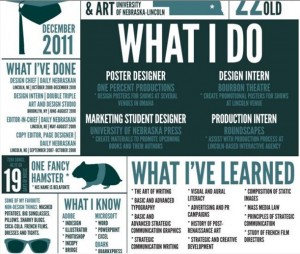 The construction of a resume is more of an art than a science. To build a great resume, you must partake in a difficult balancing act. On the one hand, you really want your resume to stand out amongst the hundreds of others. On the other hand, the manner in which it stands out must be: clever without being pretentious, cool without seeming insincere, and interesting without appearing desperate. On top of all that, the applicant must go about this process knowing that what appears unique and interesting to one employer, will come off as strange and gimmicky to another.
The truth of the matter is that there is no such thing as a perfect resume, but there are most certainly bad resumes. Bad resumes are those that are poorly written, poorly arranged, and just plain boring. While there are plenty of websites and books that can show you how to format your resume correctly, there are far fewer that can tell you how to give your resume some personality.
The first rule of resume creation is to know your audience. Today's job market is more complex then before. With many more emerging jobs in technology and web-based businesses, expectations for the traditional resume is dead. Careers at Facebook, Twitter, MySpace, and similar companies, for example, are some of the most sought-after. Decision makers for these companies clearly articulate that they look for bright, creative, industrious individuals. For someone that is trying to acquire one of those coveted social media jobs, this means, "Anything except a boring resume, please!" So how might an individual make their resume standout to someone at Facebook, Zynga, or Google?
First and foremost, your resume is a list of things that prove you have an appropriate amount of skill for the position you are seeking. You must list your education, your previous jobs, and your relevant skills. Essentially, anything that will prove to the reader that you would be great for the position. But don't stop there. You must turn your resume into an example of your impressive skillset to really excite employers. Here are a few examples to get you started:
The construction of a resume is more of an art than a science. To build a great resume, you must partake in a difficult balancing act. On the one hand, you really want your resume to stand out amongst the hundreds of others. On the other hand, the manner in which it stands out must be: clever without being pretentious, cool without seeming insincere, and interesting without appearing desperate. On top of all that, the applicant must go about this process knowing that what appears unique and interesting to one employer, will come off as strange and gimmicky to another.
The truth of the matter is that there is no such thing as a perfect resume, but there are most certainly bad resumes. Bad resumes are those that are poorly written, poorly arranged, and just plain boring. While there are plenty of websites and books that can show you how to format your resume correctly, there are far fewer that can tell you how to give your resume some personality.
The first rule of resume creation is to know your audience. Today's job market is more complex then before. With many more emerging jobs in technology and web-based businesses, expectations for the traditional resume is dead. Careers at Facebook, Twitter, MySpace, and similar companies, for example, are some of the most sought-after. Decision makers for these companies clearly articulate that they look for bright, creative, industrious individuals. For someone that is trying to acquire one of those coveted social media jobs, this means, "Anything except a boring resume, please!" So how might an individual make their resume standout to someone at Facebook, Zynga, or Google?
First and foremost, your resume is a list of things that prove you have an appropriate amount of skill for the position you are seeking. You must list your education, your previous jobs, and your relevant skills. Essentially, anything that will prove to the reader that you would be great for the position. But don't stop there. You must turn your resume into an example of your impressive skillset to really excite employers. Here are a few examples to get you started: